Showing posts with label explosive speed. Show all posts

Thursday, February 18, 2016

How to Develop Explosive Speed

by Pat Beith

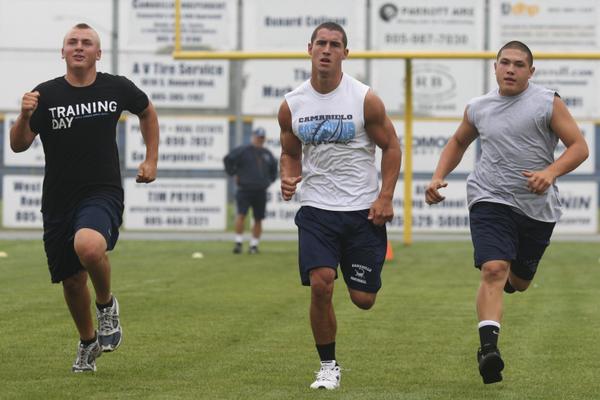
Creating a football speed program is one of the most important things a coach can do for his team.  Football is a game of speed, and I’ve seen it impact a game in more ways than I can count.  I’ve also seen a lot of coaches and athletes struggle with developing speed, so I’m going to explain some of the principles that must be understood.
An effective football speed training program should focus on teaching athletes how to move efficiently and increase the amount of force they are able to put into the ground during this movement.  Unfortunately, most coaches are still wasting a tremendous amount of their athlete’s time and energy focusing on doing drills for the sake of doing drills, without understanding how these drills are supposed to help.  They find a bunch of drills on the internet or at a camp, put them together in whatever order feels good to them, and call it a football speed training program.  Without a thorough understanding of how speed is developed, your football speed training program will never produce optimal results.  Let’s take a look at the important factors involved in an effective football speed training program.football training How To Develop Explosive Speed
Four Factors of an Effective Football Speed Training Program
An effective program has to take important pieces from several areas of science: physiology, neurology, biomechanics and motor learning.  Note that “drills” are one of the scientific areas we need to drawn upon.  Drills are simply a way to help develop one of these areas.  Understanding how a particular drill affects the human body is the key to drill selection and football speed training.
Biomechanics & Motor Learning – Athletes must learn how to put force into the ground in a way that will help them move more efficiently.  While not everyone needs to run, cut and accelerate the exact same way, there are certainly ways that are more effective than others.  These techniques need to be understood and taught to young athletes so they aren’t making gross errors in their movement.
Drills should be selected that teach athletes the best way to apply force into the ground.  They also need to be taught in a way that creates real movement changes.  I often see football speed programs that look like they address mechanics on the surface, but when you get right down to it, it’s all just fluff.  Things like A-skips, B-skips, ladder drills and mini-hurdle drills do nothing for most football players, yet we see them shoved down their throats all the time.
Rather than including a drill for the sake of including drills, understand what each drill teaches, and only select the ones that are pertinent.  Wall drills, for example, can be used to teach the mechanics of a forward lean, high knees and forceful backward push during acceleration.  If, however, you’re just throwing the drill into your program because you saw someone else do it, the drill is a waste of time.  It’s absolutely vital that you take the time to teach the athletes HOW to do the drills and HOW to move.
Keep in mind that motor learning is very specific to the skill you are practicing.  That means that you are only going to get better at the exact skill you are practicing, and very little transfer will take place from one movement to another.  In other words, practicing skips and ladder drills will get you better at skips and ladder drills.  Practicing sprinting and acceleration will get you better at sprinting and acceleration.  What do you want to get better at?
Of course, some movements are difficult to learn and require “lead-up” drills.  The wall or tall & fall drills are examples of drills that help athletes learn how to accelerate.  A drill may work perfectly for one athlete, but not all of them, so you need several ways of teaching the same skill.  Always keep in mind, however, that the goal is to teach athletes how to run faster, not how to perform a drill.  The drill should always be a means to an end.
Physiology – Once mechanics are addressed, we need to get athletes stronger so they can produce more force.  If the increased force is put into the ground with good mechanics, the athlete will run faster.  If the mechanics are not efficient, the force will not be used as effectively as possible and your results will be sub-par.
Most strength programs today include some version of a squat, which is a great place to start developing strength.  We’re not going to get into the details of squat technique, but correct form should always be used.  A good football speed training program should also include work on the hamstrings, groin and hips through exercises like glute/ham raises, RDL’s, hip extension, hip flexion, glute/hip bridges, leg curls, slideboard inner thigh, side lunges, 3-D lunges and the Nordic hamstring exercise.  I see these exercises omitted from way too many programs, so make sure you are addressing all of the muscles involved in football speed.  You don’t have to do every one of these exercises every day, but the hips, groin and hamstring should be taken as seriously as the squat.
Be progressive with every exercise you choose to maximize your strength gains.  Simply working hard is a great start, but carefully documenting your progress is a much more efficient way to develop strength.  Choose a system of progression that works for you, and stick to it for several weeks at a time before you change anything in your program.  The human body takes time to adapt to a stimulus like a strength program, so be patient and stick with your program to develop strength.
football1 How To Develop Explosive Speed
Neurology – Increasing force through physiological changes is important to increasing football speed, but increasing the speed in which your body produces that force is just as important.  The ability to produce force quickly is often referred to as power.  In speed and agility, power is important because you need to put force into the ground as quickly as possible in order to move fast.  Strength training will help make this happen, but explosive training will make it happen more efficiently.
Explosive training is all about optimizing your nervous system so your muscles will contract quickly and in a coordinated fashion that produces maximal power.  This can be accomplished through training methods such as plyometrics, weighted sleds or resisted movement, Olympic lifting, medicine balls and high speed strength exercises.
The key to enhancing your neurology is to perform the exercises with precision, maximum speed and maximum effort.  This means that you’ll be performing relatively low reps (less than 10 reps per set) with each exercise having slightly different guidelines.  You’ll also want to perform these exercises when you’re fresh and give yourself long breaks between sets.  This allows you to give maximal effort on every rep, which will train your body more effectively.
Combining these important areas of science will help you create the most effective football speed training program possible.  Understand the purpose of each drill or exercise and apply them in the most efficient manner possible.  If you follow the guidelines outlined in this article, you’ll be on your way to developing explosive football speed.
Jim Kielbaso
To see Coach Jim Kielbaso’s speed training system for football players, go check it out here at Complete Football Speed

Friday, November 14, 2014

Bodyweight Speed Drills vs. Resisted Speed Drills

Bodyweight speed drills should come before resisted speed drills. You may have seen that commercial showing an athlete doing a speed drill while pulling a sled.....that's a good exercise to do---if you're ready for it....


Unfortunately, many young athletes haven't even mastered bodyweight speed drills yet.....and, they don't have enough core strength or overall body strength to do this sled exercise the right way.

Master bodyweight speed drills before progressing to assisted or weight-bearing speed drills.The average guy or gal I see working out doesn't even run with correct running mechanics. This would be the place to start----work on running mechanics every day.

Greek researchers found that athletes training with towing methods (sleds, tires, etc.) improved their running velocity over the first 20 meters (i.e. acceleration) but that overall maximum speed did not improve.

The researchers found that unresisted sprint training techniques improved maximum speed velocity more. So, resisted and unresisted training has a place in the overall speed training program. Finally, the researchers found that towing sleds that were too heavy forced the athletes to use bad running mechanics.

Some good bodyweight speed drills to do:

1. Form running
2. Long jumps
3. Vertical jumps
4. Speed shuttles
5. Box jumps
6. Pogo jumps
7. Speed ladder drills
8. Side shuffles
9. Front-to-back hops
10. Side-to-side hops
11. Acceleration starts of 10-20 yards
12. Bounding
13. Speed step ups (knee high platform)

Don't do an exercise just because you see it on television or in a magazine! You may not be ready for that exercise.

Be sure and download your Free Bodyweight 500 Metabolic Fat Burner Workouts and start burning fat and to shape your athletic body!

Mark Dilworth, BA, PES
Your Fitness University
My Fitness Hut
Her Fitness Hut
Sports Fitness Hut


Wednesday, September 24, 2014

Top 10 Athlete's Strength and Power Training Techniques

As an athlete, you need certain strength and power training techniques to help you succeed in your sport. It is not enough to train hard. You must train smart also.


One important thing to remember about sports fitness training is that it is not a strongman contest!  Too many times there is too much emphasis placed on "maxing out" with the weights.

To continually get stronger without an increase in speed, power and athleticism will do you no good. An overall athletic training framework for you to follow is.....


1. Train your body in all 3 planes of motion. Many athletic movements happen in the transverse plane (rotations, turning, twisting, etc.) and frontal plane (side-to-side, lateral).

Machine-based training concentrates on the sagittal plane (up- down, forward-backward movements). Do miminal athletic training on machines because they limit your natural movement patterns.

2. Train on your feet because most athletic movements in games are done standing and running.

3. Stabilize and strengthen the core first and limbs (arms and legs) later.

This can be done using exercises like bridges, planks, bird dogs, cobras, supermans and back extensions. You would later progress to full speed core exercises on your feet like medicine ball chops, medicine ball slams, 2-arm and 1-arm medicine ball throws and medicine ball rotational throws.

4. The same holds true for body strength exercises. Start with dumbbells to stabilize your joints.Dumbbells also don't allow you to cheat when 1 arm or 1 leg is weaker than the other.

Also, bodyweight exercises work well to stabilize your body strength. You can get to the heavier weights once your joints and muscles are stabilized and balanced. If you can't do bodyweight squats correctly then you won't do heavyweight squats correctly.

5. Continuing with strength exercises....concentrate on compound (multi-joint) exercises like squats of all types, lunges of all types, bench press, rows, step ups, and deadlifts.

One-legged squats, step ups and lunges improve your running strength and power because about 80% of running is done on one leg. Do less single-joint exercises like bicep curls, calf raises and leg extensions because you get little benefit.

6. And, improve your muscular balance. Quadriceps shouldn't be significantly stronger than hamstrings. Likewise, the frontside of your upper body should have muscular balance with the backside of your upper body.

7. Train your muscles with all contraction types (eccentric, isometric, concentric). All muscles function eccentrically (reduces force or deceleration), isometrically (stabilizes force) and concentrically (produces force).

Eccentric contractions are able to produce the most tension development followed by isometric contractions and lastly, concentric contractions. If eccentric contractions are able to produce the greatest tension development, then more time should be devoted during training for eccentric contractions to reduce the risk of injuries such as knee ACL tears.

Also, strong eccentric contractions are critical for athletes to produce maximal power since all force production (concentric) must be preceded by force reduction (eccentric).


8. Improve your flexibility and correct postural problems in the early stages of your training to avoid injuries when you get to more intense training.

9. Progress to more intense exercises like plyometrics, speed training and full-speed sport specific exercises after you have stabilized and strengthened your core, joints and overall muscle structure.

At this stage, you will train athletic movements in your sport (transfer-of-training effect) and not just muscles.YOU MUST TRAIN FAST AND EXPLOSIVE TO GET FASTER AND MORE EXPLOSIVE.

10. Rate-of-force production (how fast your muscles produce force) and dynamic balance are the two best physical predictors of athletic success. Your training program (strength, power, speed, flexibility, etc.) should be pointed toward improving these 2 physical traits.

Train harder, smarter and safely!

Download your FREE 10-Minute Strength and Power Workouts now!

Other things being equal, a muscular, powerful athlete will outperform a fat, slower or skinny, weaker athlete. Sports Fitness Hut's Fat Blaster Athletic Power Training System will give you your "lean and mean" athletic machine!

Mark Dilworth, BA, PES
Sports Fitness Hut


Saturday, July 5, 2014

How Athlete's Bodyweight Strength Training Powers Explosion

Build your athletic body with strength and power training to explode your body past your opponent. Stay stronger and more explosive for longer periods during your games and you will win most of them!


Overall body strength training is a given.  Core strength training is where many athletes fall short.  Since all movement begins with the core, you can't take shortcuts or your power and explosion will suffer.  Your power will experience a shortage before it reaches your arms and legs.

See 5 -Part Core Training Series

The goal of the core training program is for you to develop optimal levels of functional strength and dynamic stabilization.

You can start at the highest level of core stabilization training you can control. As with other areas of integrated training, a core training program should be:

1. progressive, systematic, sport-specific and challenging,

2. multi-planar (sagittal, frontal, transverse), multi-dimensional (stabilization, strength, power) and variable (sets, repetitions, intensity, etc.),

3. varied with contraction velocities (different speeds), and

4. varied with modes of training (airex pads, foam, floor, disc, etc.) and body positions.

Core training exercise progressions should follow these paths:

1. Slow to Fast
2. Known to Unknown
3. Stable to Controlled to Dynamic
4. Low Force to High Force
5. Correct Execution to Increased Intensity

One of the first signs of fatigue that I look for in an athlete is whether he or she can remain strong and upright towards the end of the game. If your core is weak, you will start to "bend over" and lose power and explosiveness when you run. Next, your arms will start to "flail" instead of pumping powerfully to fuel your running.

Adequate core strength helps your speed endurance, which is the ability to maintain maximum velocity or a percentage of maximum velocity for a prolonged period of time or in a fatigued state. The best players and teams have excellent overall body strength, core strength and speed endurance (and they win the most games).

Interval training for speed endurance is different than regular speed training. Speed endurance sprint intervals last from 30 seconds to 3 minutes. Also, recovery time is reduced to prevent complete recovery by the athlete. Here is an example of speed endurance training:

Shuttles - Place cones at 5, 10, 15, 20 and 30 yards. You would sprint to the 5 yard cone and sprint back to the start. You would then sprint to the 10 yard cone and sprint back to the start. The same would be done at the 15, 20 and 30 yard cones. That is one set. Rest for 2 minutes between sets. Do 5-6 sets.

Get after it with the following download.....

Free Bodyweight 500 Metabolic Fat Burner Workouts

Mark Dilworth, BA, PES
Your Fitness University
My Fitness Hut
Her Fitness Hut
Sports Fitness Hut

Saturday, May 24, 2014

How to Improve Muscle Activation and Sports Power

Sports power training teaches you how to activate the right muscles (prime movers and synergists) at the right time. Sports power training also provides you with optimal neuromuscular efficiency.


There are five purposes for sports power training:

1. Improve the excitability, sensitivity and reactivity of the neuromuscular system.

2. Improve the rate-of-force production.

3. Increase motor-unit recruitment.

4. Increase motor-unit firing frequency.

5. Increase motor-unit synchronization.

Speed strength is a combination of starting speed, explosive speed (maximum velocity in the shortest time) and reactive speed.

Speed strength is also known as power. Proper training methods will produce the strength, power and speed you will need to succeed in your sport.

The three building blocks of integrated training for the athlete are:

STABILIZATION (2 Phases) – Primary goals are to correct muscle imbalances, joint dysfunctions, postural distortion patterns, improve kinetic chain (human movement system), integrity and recondition/rehabilitate.

STRENGTH (3 Phases) – Primary goals are to improve stabilization strength/endurance and increase muscle hypertrophy (growth) and strength.

POWER (2 Phases) – Primary goals are to enhance neuromuscular efficiency, increase power production, increase speed strength and create neuromuscular adaptations throughout the entire range of motion.

All seven phases of training may not be necessary for all athletes. For example, some sports do not require optimum levels of muscle hypertrophy.

The training program is Multi-Planar (sagittal, frontal, transverse), Multi-Joint (exercises such as bench press, squats, lunges), Multi-Dimensional (stabilization, strength, power) , Proprioceptively Enriched (high neural demand) and Sport-Specific.

You should follow a systematic approach with the following goals in mind: injury prevention, body fat reduction and increased lean muscle mass, strength, endurance, flexibility and performance.

Rate-of-Force Production (muscles producing force in the shortest period of time) is one of the best physical indicators of the level of an athlete’s performance and future success.

After an adequate strength foundation has been built, you can work on increasing speed strength. This is best done by using a combination of:

1) Plyometrics
2) High speed medicine ball exercises
3) High speed weight training exercises
4) Multidimensional speed training exercises

Download your FREE 10-Minute Strength and Power Workouts now!

Mark Dilworth, BA, PES
Sports Fitness Hut


Thursday, May 15, 2014

Top Explosive Athlete's Training Technique

Become a more explosive athlete with eccentric contraction strength training. This type of training will improve your strength in a way that will maximize your power output and reduce risk of injuries.


Strong eccentric contractions are critical for you to produce maximal power since all force production (concentric) must be preceded by force reduction (eccentric). An example would be loading up in your squat to do an explosive squat jump (a plyometric exercise).

Plyometric exercises always follow the same order: a landing phase, an amortization phase and the take off.

The landing phase starts when the muscles start an eccentric contraction. The rapid eccentric contraction stretches the elastic component of the muscle and activates the stretch reflex. A high level of eccentric strength is needed during the landing phase. Inadequate strength will result in a slow rate of stretch and less activation of the stretch reflex.

The amortization phase, the time on the ground, is the most important part of a plyometric exercise. It represents the time between the landing and the take off and is critical for power development. If the amortization phase is too long, the stretch reflex is lost and there is no plyometric effect.

The take off is the concentric contraction that follows the landing. During this phase the stored elastic energy is used to increase jump height and explosive power.

Strength train your muscles with all contraction types (eccentric, isometric, concentric). All muscles function eccentrically (reduces force or deceleration), isometrically (stabilizes force) and concentrically (produces force).

Eccentric contractions are able to produce the most tension development followed by isometric contractions and lastly, concentric contractions.

If eccentric contractions are able to produce the greatest tension development, then more time should be devoted during training for eccentric contractions to reduce the risk of injuries such as knee ACL tears and improve power.

You would train for eccentric contractions this way:

Eccentric muscle contraction weight training is the lowering phase (force reduction) of a lift.

For example, you would lift the weight (concentric or force production) for a hamstring curl for one count and lower the weight for 3-4 counts. For bench press, lift the weight for 1 count and lower the weight for 3-4 counts.

Become a more explosive athlete by training correctly for power!

Download your FREE 10-Minute Strength and Power Workouts now!

Mark Dilworth, BA, PES
Your Fitness University
My Fitness Hut
Her Fitness Hut
Sports Fitness Hut


Friday, May 9, 2014

How Change-of-Direction Speed Improves with Core Strength

You have to train purposely to improve your change-of-direction speed (quickness and agility).

In many instances, quickness is more important than straight ahead speed. In many sports, maximum speed is rarely reached or needed, but explosive reaction is often necessary. Athletes can improve reaction times by training to make the right choices (choice reaction).


Reaction time is the ability to respond quickly with proper posture and control to a stimulus such as sound or sight.

How many times have you seen a player with "not great speed" repeatedly make plays to help the team win. This is not an accident. You can improve your change-of-direction speed with proper training. Read my post that discusses change-of-direction speed in detail.

Improve your change-of-direction speed these 3 ways:

1. As with any athletic move, core strength is critical. Overall body strength is also important.

Before you begin to train for speed and power, the foundation should be laid with sufficient core and body strength. Failure to lay this strength foundation will lead to certain injuries for you.

2. Body positioning is critical if you want to improve your change-of-direction speed. You will need dynamic balance. In many sports, it is not that easy to change direction and accelerate because the athlete is often off balance.

Some sports, such as football and basketball require running with or bouncing a ball. And, other sports, such as soccer require moving a ball with the feet. The best running backs, tennis players, basketball players, shortstops, etc. all have great dynamic balance.

Having great dynamic balance means that you are able to maintain your center of gravity over a constantly changing base of support. Thus, quickness and agility drills help you to improve dynamic balance and change-of-direction acceleration while not wasting motion.

3. To improve change-of-direction acceleration, you should have a shin angle of approximately 45 degrees for the first few steps. Your shoulders should also be slightly leaned forward.

The body lean should be at the ankles and not the hips. Having the feet just wider than shoulder-width apart will give you the most stable base of support. This is not always possible during athletic competition.

Therefore, stability needs to be added by lowering the center of gravity. Change-of-direction acceleration could be laterally, at an angle or forward (when back pedaling) and will catapult you to near maximal speed quickly.

The first step in the change-of-direction is important. If this step is too long, you will over-stride and bring the shin to a vertical angle instead of 45 degrees. This will slow you down. So, the first step should be under your hips. Again, the body lean should be at ankles and not the hips.

Improving your coordination will help improve your multi-directional speed and linear speed (straight-ahead speed). A player rarely reaches maximum speed during game competition.

Having great change-of-direction speed (agility with quickness) allows you to beat your opponent "to the spot" or recover from mistakes in positioning.

Improve your quickness and agility with these drills and then apply them during your movements in a game:

a. jump rope (one foot, two feet, slalom, Ali shuffle, backpedal)

b. speed ladder drills

c. cariocas, tapiocas, back pedals, shuffles, toe taps

d. hip turn and hip flexibility drills (like leg swings)

Work hard and expect success!

Download your FREE 10-Minute Strength and Power Workouts now!

Mark Dilworth, BA, PES
Your Fitness University
My Fitness Hut
Her Fitness Hut
Sports Fitness Hut


Saturday, March 29, 2014

Calf Muscles Improve Power and Explosive Speed

Everybody's looking for NEW ways to improve running speed....sometimes, the simple answer is right there in front of you....pay more attention to training your lower legs for strength and power....


The lower legs can provide 20% to 25% of the power needed for an explosive start. And, explosive starts can be the difference in you making the play or winning the race.

Rate-of-force production (how fast your muscles produce force) or speed strength is one of the best indicators of whether you will succeed in your sport.

When you plan your workout routine, include more calf muscle exercises like:

1) Explosive standing dumbbell calf raises (go as fast as possible to failure 3-4 sets). You can progress to one-legged calf raises (pictured above).

2) Explosive lifts on the leg press with only your toes lifting the weight (3 sets/20 repetitions). You can progress to one-legged lifts.

3) Barbell calf raises using jumping motion (explode upward on your toes as if you are jumping). Do 3 sets of 20 repetitions. Progress to one-legged raises.

You can work the calf muscles more frequently than other muscle groups (up to 4 times a week) because they bounce back faster.

Its also important to do static calf stretches after your workout to bring muscles back to their normal length.

Get Faster, Sooner!

Download your FREE 10-Minute Strength and Power Workouts now!

Mark Dilworth, BA, PES
Sports Fitness Hut


Saturday, March 15, 2014

8 Tips for Athletes to Improve Dynamic Balance

If you want to be an elite athlete, improve your dynamic balance.


Here are 8 training tips to improve dynamic balance:

1. Incorporate many one-legged exercises such as power step ups, single leg squats, single leg good mornings, single leg medicine ball exercises, etc.

2. Include exercises with your eyes closed to improve limb position sense (proprioception).

3. Train your body in all 3 planes of motion to improve multi-planar balance. An example would be a grouping of walking lunges, side lunges and transverse lunges.

4. Train on different surfaces such as grass, sand, astro-play and soft surfaces. You will rarely play on a perfect surface anyway.

5. Do combinations of one-arm and one-leg exercises such as single leg squat-to-single arm shoulder press.

6. Jump rope every day using different variations---two feet, one foot, shuffle, etc. Jumping rope is one of the best body coordination exercises out there. And, speed jump rope is even better.

7. Better muscular balance will give you better dynamic balance. For example, your quadriceps should not be significantly stronger than your hamstrings.

8. Quickness and agility drills will improve your dynamic balance.

Balance training also improves your core strength. Balance exercises should closely mimic those actions required by your sport.

Train hard and smart!

Download your FREE 10-Minute Strength and Power Workouts now!

Mark Dilworth, BA, PES
Sports Fitness Hut


Saturday, January 4, 2014

Train Fast-Twitch Muscle Fibers for Speed and Explosion

To improve your speed and explosiveness, train and activate the bulkier fast-twitch muscle fibers often.  Speed training athletes shouldn't do much slow, long distance running during training.  If you do too much long distance running, your slow-twitch muscle fibers will take over and make you slower and nonexplosive.


What about speed endurance training? This is something totally different. Speed endurance is the ability to maintain maximum velocity or a percentage of maximum velocity for a prolonged period of time or in a fatigued state.

When you are fatigued, it is important to maintain proper running mechanics. Doing so will give you an edge over your opponent.

Several sports require speed endurance including football, lacrosse, basketball, soccer, field hockey and tennis. These sports require repeated sprints followed by short periods of rest (walking or jogging).

Interval training for speed endurance is different than regular speed training. Speed endurance sprint intervals last from 30 seconds to 3 minutes. Also, recovery time is reduced to prevent complete recovery by the athlete.

I was once asking a client about running exercises they were doing in school athletics to improve running speed. The answer was disappointing and typical.

Some of the running drills were:

1. mile runs
2. stadium steps for endurance
3. gasers for conditioning

"Did you run any sprints?" "No." Guess what? Those athletes aren't getting any faster....they are just basically running for conditioning.

Conditioning has its place but if you want to get faster, you have to train fast. That means sprinting drills with enough recovery time to run each sprint full speed. About 1 minute of recovery time is needed for each 10 yards sprinted (50 yard sprints need about 5 minutes recovery time).

Running sprints after practice won't get the job done either. Players are too tired at this point to give maximum effort. So, coaches, do your sprinting drills at the beginning of practice when your players are fresh.

Explosive strength training can also train and activate your fast-twitch muscle fibers.

Train hard and smart to get faster.......Check out Perform Better.

Mark Dilworth, BA, PES
Sports Fitness Hut


Thursday, December 12, 2013

Top Power Running Technique Improves Speed

Run faster by applying more force to the ground when you run. The more force you apply to the ground, the more the ground will "give you power."


You have to train correctly to improve your running speed. Its not magic tricks, its hard work done the right way--again and again and again.

You can improve your running speed no matter who you are! Fact is, you won't be your best until you can run as fast as you can.

First, you should practice the running mechanics every day to improve your running efficiency and straight-ahead speed.

Second, continually strengthen your body (core included). You can't reach your running speed potential with a weak body.

Apply more force to the ground with your feet. Every action has an equal and opposite reaction.  Again, the more force you apply to the ground, the more the ground will "give you power."

When you run, don't lift your knee past your "thigh being parallel" to the ground. This way, you will use your "power center" (glutes and hamstrings) to apply force to the ground instead of the less powerful hip flexors.

In other words, running "with high knees" is not the best way to run. Also, step over the opposite knee and drive the foot down into the ground to create maximum force.

Practice this power running technique to help you run faster!

Download your FREE 10-Minute Strength and Power Workouts now!

Mark Dilworth, BA, PES
Sports Fitness Hut


Saturday, November 23, 2013

Rate-of-Force Production Powers Athletic Moves

Rate-of-force production or speed strength is one of the best indicators of whether you will succeed in your sport. You have to do more than pass the eyeball test. Sooner or later, you must prove it on the field or court. The game is your ultimate evaluator, not your height and weight.


Speed strength is a combination of starting speed, explosive speed (maximum velocity in the shortest time) and reactive speed.

Speed strength is also known as power. Proper training methods will produce the strength, power and speed the athlete needs to succeed in his or her sport.

The three building blocks of integrated training for the athlete are:

STABILIZATION (2 Phases) – Primary goals are to correct muscle imbalances, joint dysfunctions, postural distortion patterns, improve kinetic chain (human movement system), integrity and recondition/rehabilitate.

STRENGTH (3 Phases) – Primary goals are to improve stabilization strength/endurance and increase muscle hypertrophy (growth) and strength.

POWER (2 Phases) – Primary goals are to enhance neuromuscular efficiency, increase power production, increase speed strength and create neuromuscular adaptations throughout the entire range of motion.

All seven phases of training may not be necessary for all athletes. For example, some sports do not require optimum levels of muscle hypertrophy.

The training program is Multi-Planar (sagittal, frontal, transverse), Multi-Joint (exercises such as bench press, squats, lunges), Multi-Dimensional (stabilization, strength, power) , Proprioceptively Enriched (high neural demand) and Sport-Specific.

You should follow a systematic approach with the following goals in mind: injury prevention, body fat reduction and increased lean muscle mass, strength, endurance, flexibility and performance.

Rate-of-Force Production (muscles producing force in the shortest period of time) is one of the best physical indicators of the level of an athlete’s performance and future success.

After an adequate strength foundation has been built, you can work on increasing speed strength. This is best done by using a combination of:

1) Plyometrics
2) High speed medicine ball exercises
3) High speed weight training exercises
4) Multidimensional speed training exercises

Download your FREE 10-Minute Strength and Power Workouts now!

Mark Dilworth, BA, PES
Sports Fitness Hut