Showing posts with label Dynamic Flexibility. Show all posts

Thursday, February 18, 2016

How to Develop Explosive Speed

by Pat Beith

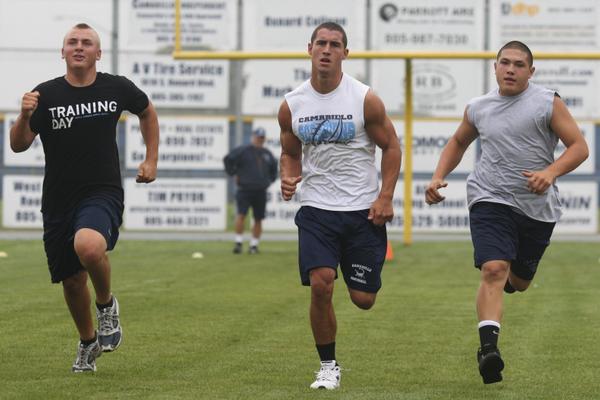
Creating a football speed program is one of the most important things a coach can do for his team.  Football is a game of speed, and I’ve seen it impact a game in more ways than I can count.  I’ve also seen a lot of coaches and athletes struggle with developing speed, so I’m going to explain some of the principles that must be understood.
An effective football speed training program should focus on teaching athletes how to move efficiently and increase the amount of force they are able to put into the ground during this movement.  Unfortunately, most coaches are still wasting a tremendous amount of their athlete’s time and energy focusing on doing drills for the sake of doing drills, without understanding how these drills are supposed to help.  They find a bunch of drills on the internet or at a camp, put them together in whatever order feels good to them, and call it a football speed training program.  Without a thorough understanding of how speed is developed, your football speed training program will never produce optimal results.  Let’s take a look at the important factors involved in an effective football speed training program.football training How To Develop Explosive Speed
Four Factors of an Effective Football Speed Training Program
An effective program has to take important pieces from several areas of science: physiology, neurology, biomechanics and motor learning.  Note that “drills” are one of the scientific areas we need to drawn upon.  Drills are simply a way to help develop one of these areas.  Understanding how a particular drill affects the human body is the key to drill selection and football speed training.
Biomechanics & Motor Learning – Athletes must learn how to put force into the ground in a way that will help them move more efficiently.  While not everyone needs to run, cut and accelerate the exact same way, there are certainly ways that are more effective than others.  These techniques need to be understood and taught to young athletes so they aren’t making gross errors in their movement.
Drills should be selected that teach athletes the best way to apply force into the ground.  They also need to be taught in a way that creates real movement changes.  I often see football speed programs that look like they address mechanics on the surface, but when you get right down to it, it’s all just fluff.  Things like A-skips, B-skips, ladder drills and mini-hurdle drills do nothing for most football players, yet we see them shoved down their throats all the time.
Rather than including a drill for the sake of including drills, understand what each drill teaches, and only select the ones that are pertinent.  Wall drills, for example, can be used to teach the mechanics of a forward lean, high knees and forceful backward push during acceleration.  If, however, you’re just throwing the drill into your program because you saw someone else do it, the drill is a waste of time.  It’s absolutely vital that you take the time to teach the athletes HOW to do the drills and HOW to move.
Keep in mind that motor learning is very specific to the skill you are practicing.  That means that you are only going to get better at the exact skill you are practicing, and very little transfer will take place from one movement to another.  In other words, practicing skips and ladder drills will get you better at skips and ladder drills.  Practicing sprinting and acceleration will get you better at sprinting and acceleration.  What do you want to get better at?
Of course, some movements are difficult to learn and require “lead-up” drills.  The wall or tall & fall drills are examples of drills that help athletes learn how to accelerate.  A drill may work perfectly for one athlete, but not all of them, so you need several ways of teaching the same skill.  Always keep in mind, however, that the goal is to teach athletes how to run faster, not how to perform a drill.  The drill should always be a means to an end.
Physiology – Once mechanics are addressed, we need to get athletes stronger so they can produce more force.  If the increased force is put into the ground with good mechanics, the athlete will run faster.  If the mechanics are not efficient, the force will not be used as effectively as possible and your results will be sub-par.
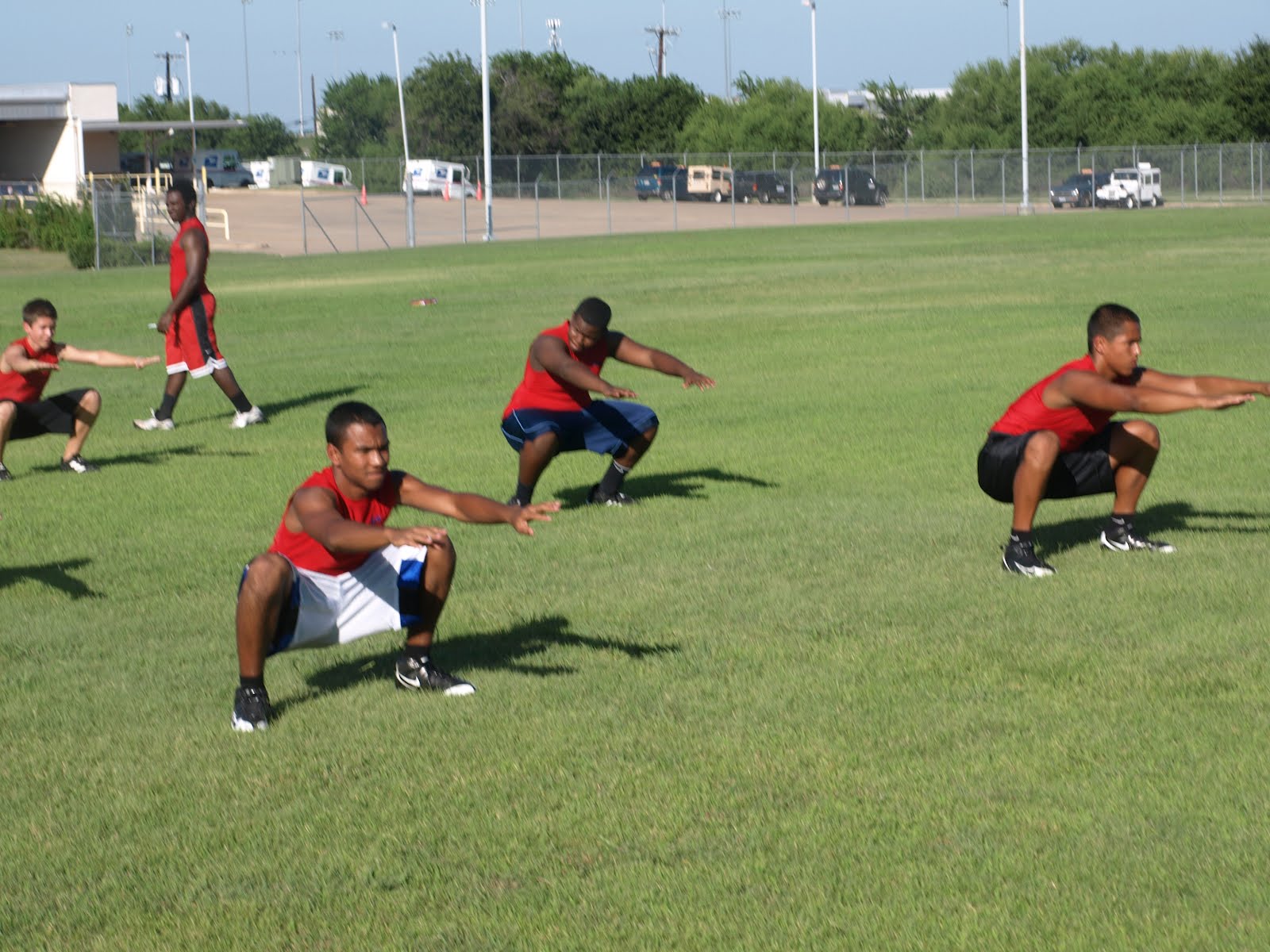
Most strength programs today include some version of a squat, which is a great place to start developing strength.  We’re not going to get into the details of squat technique, but correct form should always be used.  A good football speed training program should also include work on the hamstrings, groin and hips through exercises like glute/ham raises, RDL’s, hip extension, hip flexion, glute/hip bridges, leg curls, slideboard inner thigh, side lunges, 3-D lunges and the Nordic hamstring exercise.  I see these exercises omitted from way too many programs, so make sure you are addressing all of the muscles involved in football speed.  You don’t have to do every one of these exercises every day, but the hips, groin and hamstring should be taken as seriously as the squat.
Be progressive with every exercise you choose to maximize your strength gains.  Simply working hard is a great start, but carefully documenting your progress is a much more efficient way to develop strength.  Choose a system of progression that works for you, and stick to it for several weeks at a time before you change anything in your program.  The human body takes time to adapt to a stimulus like a strength program, so be patient and stick with your program to develop strength.
football1 How To Develop Explosive Speed
Neurology – Increasing force through physiological changes is important to increasing football speed, but increasing the speed in which your body produces that force is just as important.  The ability to produce force quickly is often referred to as power.  In speed and agility, power is important because you need to put force into the ground as quickly as possible in order to move fast.  Strength training will help make this happen, but explosive training will make it happen more efficiently.
Explosive training is all about optimizing your nervous system so your muscles will contract quickly and in a coordinated fashion that produces maximal power.  This can be accomplished through training methods such as plyometrics, weighted sleds or resisted movement, Olympic lifting, medicine balls and high speed strength exercises.
The key to enhancing your neurology is to perform the exercises with precision, maximum speed and maximum effort.  This means that you’ll be performing relatively low reps (less than 10 reps per set) with each exercise having slightly different guidelines.  You’ll also want to perform these exercises when you’re fresh and give yourself long breaks between sets.  This allows you to give maximal effort on every rep, which will train your body more effectively.
Combining these important areas of science will help you create the most effective football speed training program possible.  Understand the purpose of each drill or exercise and apply them in the most efficient manner possible.  If you follow the guidelines outlined in this article, you’ll be on your way to developing explosive football speed.
Jim Kielbaso
To see Coach Jim Kielbaso’s speed training system for football players, go check it out here at Complete Football Speed

Wednesday, September 24, 2014

Top 10 Athlete's Strength and Power Training Techniques

As an athlete, you need certain strength and power training techniques to help you succeed in your sport. It is not enough to train hard. You must train smart also.


One important thing to remember about sports fitness training is that it is not a strongman contest!  Too many times there is too much emphasis placed on "maxing out" with the weights.

To continually get stronger without an increase in speed, power and athleticism will do you no good. An overall athletic training framework for you to follow is.....


1. Train your body in all 3 planes of motion. Many athletic movements happen in the transverse plane (rotations, turning, twisting, etc.) and frontal plane (side-to-side, lateral).

Machine-based training concentrates on the sagittal plane (up- down, forward-backward movements). Do miminal athletic training on machines because they limit your natural movement patterns.

2. Train on your feet because most athletic movements in games are done standing and running.

3. Stabilize and strengthen the core first and limbs (arms and legs) later.

This can be done using exercises like bridges, planks, bird dogs, cobras, supermans and back extensions. You would later progress to full speed core exercises on your feet like medicine ball chops, medicine ball slams, 2-arm and 1-arm medicine ball throws and medicine ball rotational throws.

4. The same holds true for body strength exercises. Start with dumbbells to stabilize your joints.Dumbbells also don't allow you to cheat when 1 arm or 1 leg is weaker than the other.

Also, bodyweight exercises work well to stabilize your body strength. You can get to the heavier weights once your joints and muscles are stabilized and balanced. If you can't do bodyweight squats correctly then you won't do heavyweight squats correctly.

5. Continuing with strength exercises....concentrate on compound (multi-joint) exercises like squats of all types, lunges of all types, bench press, rows, step ups, and deadlifts.

One-legged squats, step ups and lunges improve your running strength and power because about 80% of running is done on one leg. Do less single-joint exercises like bicep curls, calf raises and leg extensions because you get little benefit.

6. And, improve your muscular balance. Quadriceps shouldn't be significantly stronger than hamstrings. Likewise, the frontside of your upper body should have muscular balance with the backside of your upper body.

7. Train your muscles with all contraction types (eccentric, isometric, concentric). All muscles function eccentrically (reduces force or deceleration), isometrically (stabilizes force) and concentrically (produces force).

Eccentric contractions are able to produce the most tension development followed by isometric contractions and lastly, concentric contractions. If eccentric contractions are able to produce the greatest tension development, then more time should be devoted during training for eccentric contractions to reduce the risk of injuries such as knee ACL tears.

Also, strong eccentric contractions are critical for athletes to produce maximal power since all force production (concentric) must be preceded by force reduction (eccentric).


8. Improve your flexibility and correct postural problems in the early stages of your training to avoid injuries when you get to more intense training.

9. Progress to more intense exercises like plyometrics, speed training and full-speed sport specific exercises after you have stabilized and strengthened your core, joints and overall muscle structure.

At this stage, you will train athletic movements in your sport (transfer-of-training effect) and not just muscles.YOU MUST TRAIN FAST AND EXPLOSIVE TO GET FASTER AND MORE EXPLOSIVE.

10. Rate-of-force production (how fast your muscles produce force) and dynamic balance are the two best physical predictors of athletic success. Your training program (strength, power, speed, flexibility, etc.) should be pointed toward improving these 2 physical traits.

Train harder, smarter and safely!

Download your FREE 10-Minute Strength and Power Workouts now!

Other things being equal, a muscular, powerful athlete will outperform a fat, slower or skinny, weaker athlete. Sports Fitness Hut's Fat Blaster Athletic Power Training System will give you your "lean and mean" athletic machine!

Mark Dilworth, BA, PES
Sports Fitness Hut


Saturday, June 7, 2014

Do Walking Lunges for Strength, Power and Speed

Use walking lunges as part of your dynamic warm-up or as a strength exercise.....walking lunges are great for adding muscular balance and dynamic balance to your lower body because you work one leg at a time and you can't "cheat."


See my post here for a detailed discussion of hamstring flexibility and strength.


The walking lunge can be a great strength and flexibility exercise for your hamstrings. The further you "lunge out" with the lead leg, the more your hamstrings are worked.

And, if you don't "lunge out" very far, your quadriceps will get more work than your hamstrings. The quadriceps get plenty of work with other exercises like leg presses, squats and leg extensions.

You also need adequate core strength to keep your body upright during the walk. Walking lunges also improve your speed because you use the same pathways it takes to run fast.

When you do the walking lunge, don't let your front knee go past your foot and don't let your back knee touch the ground on the descent. Also, don't let the front thigh go past parallel to the ground.

Include this staple exercise in your workouts!

Be sure and download your Free Bodyweight 500 Metabolic Fat Burner Workouts and start building your body naturally and powerful!  There are 3 levels:  beginner, intermediate and advanced.  Start at your level and progress.

Mark Dilworth, BA, PES
Sports Fitness Hut


Tuesday, May 13, 2014

Stretch Tight Hip Flexors with External and Internal Hip Rotations

If you have tight hip flexors, a good dynamic flexibility exercise for you would be hip rotations.


See Flexibility and Stretching 101

Do external and internal hip rotations every day to improve your speed and athleticism.

If your hip flexor muscles are not flexible, you will not even be a good athlete in your sport(s). Tight hip flexors also lead to some painful injuries (like pulls and strains) that are hard to recover from. Every athletic movement involves your hips so condition them continually.

Great athletes dominate dynamic movements with the hips, glutes, quadriceps and hamstrings. Lateral speed is particularly created and maintained by the strength of the glutes and hips. There are a host of injuries that arise when your hips are tight causing your glutes to not fire properly.

Be sure and download your Free Bodyweight 500 Metabolic Fat Burner Workouts and start shaping your body faster!  There are 3 levels:  beginner, intermediate and advanced.  Start at your level and progress.

Mark Dilworth, BA, PES
Sports Fitness Hut


Saturday, April 5, 2014

Gluteus Medius Training Avoids Injuries

Don't neglect to train the gluteus medius. Weakness in the gluteus medius can result in knee and back injuries.


Weakness in the gluteus medius also contributes to instability when you walk, run and jump. In other words, you will avoid alot of injuries just by training the darn gluteus medius!


The gluteus medius is the main hip abductor. It moves your hip away from your body's midline.

See Top 10 Speed Training Tips

Abduction occurs during any athletic movement requiring you to move from side to side such as playing the infield in baseball, defense in basketball and football, and ice skating. The gluteus medius and gluteus minimus also have critical roles in gait (walking) because they stabilize the pelvis. This prevents the pelvis from tilting sideways when you are balancing on one foot.

According to Laura Presswood and colleagues from New Zealand, the following exercises are great for strengthening and conditioning the gluteus medius:

1. Side lying leg lifts
2. Single-leg squats
3. Lunges
4. Cable or resistance band hip abductions
5. Balancing on one leg

I would also add step ups and leg swings to this list.

The gluteus medius causes running injuries for many athletes. Because you run on one leg at a time, a weak gluteus medius will always cause running mechanics problems and injuries.

It is important to keep your hips and glutes conditioned all year.

Be sure and download your Free Bodyweight 500 Metabolic Fat Burner Workouts and start shaping your body faster!  There are 3 levels:  beginner, intermediate and advanced.  Start at your level and progress.

Mark Dilworth, BA, PES
Sports Fitness Hut

Saturday, March 15, 2014

8 Tips for Athletes to Improve Dynamic Balance

If you want to be an elite athlete, improve your dynamic balance.


Here are 8 training tips to improve dynamic balance:

1. Incorporate many one-legged exercises such as power step ups, single leg squats, single leg good mornings, single leg medicine ball exercises, etc.

2. Include exercises with your eyes closed to improve limb position sense (proprioception).

3. Train your body in all 3 planes of motion to improve multi-planar balance. An example would be a grouping of walking lunges, side lunges and transverse lunges.

4. Train on different surfaces such as grass, sand, astro-play and soft surfaces. You will rarely play on a perfect surface anyway.

5. Do combinations of one-arm and one-leg exercises such as single leg squat-to-single arm shoulder press.

6. Jump rope every day using different variations---two feet, one foot, shuffle, etc. Jumping rope is one of the best body coordination exercises out there. And, speed jump rope is even better.

7. Better muscular balance will give you better dynamic balance. For example, your quadriceps should not be significantly stronger than your hamstrings.

8. Quickness and agility drills will improve your dynamic balance.

Balance training also improves your core strength. Balance exercises should closely mimic those actions required by your sport.

Train hard and smart!

Download your FREE 10-Minute Strength and Power Workouts now!

Mark Dilworth, BA, PES
Sports Fitness Hut


Saturday, October 27, 2012

Video: The IT Band Friction Fix

If you have been training and/or running for any length of time, you are probably experiencing mild or acute IT Band friction.

According to certified personal trainer and professional triathlete Ben Greenfield:

"If you simply fight through the pain and try to just live with your IT band friction syndrome and tendonitis, you will eventually destroy your knee."

Take a look at this short video:


Just click here to learn how to Bulletproof Your Knee with the IT Band Friction Fix!

Mark Dilworth, BA, PES Your Fitness University My Fitness Hut Her Fitness Hut Sports Fitness Hut

Friday, October 12, 2012

7 Tips to Improve Speed Strength and Dynamic Balance

Speed strength and dynamic balance are the two best physical predictors of success in speed-based sports such as football, basketball, soccer, lacrosse and baseball. If you want to be your best version of athlete, you need high levels of both.


Speed Strength

1. Speed strength, or how fast your muscles can produce force, is the key to improving your speed and power. Just getting stronger will not continually improve your speed and power. You must train your muscles to move faster with the correct motions.


There is a point at which increasing strength will not result in an increase in power.

2. There are five purposes for sports power training:

a. Improve the excitability, sensitivity and reactivity of the neuromuscular system.

b. Improve the rate-of-force production.

c. Increase motor-unit recruitment.

d. Increase motor-unit firing frequency.

e. Increase motor-unit synchronization.

Sports power training teaches you how to activate the right muscles (prime movers and synergists) at the right time. Sports power training also provides you with optimal neuromuscular efficiency.

3. Here are some ways to train your muscles to move faster:

a. Sprinting with maximum effort and with the correct running mechanics. You have to train fast to get faster.

b. Do plyometric exercises.


c. Do weight training exercises at full speed.

d. Build muscle mass, especially bulky fast twitch muscle fibers.

e. Improve your dynamic flexibility so your body can move efficiently.

Dynamic Balance

4. Improve your dynamic balance and proprioception (limb position sense) and you will be a better athlete.

Your ability to maintain your center of gravity over a constantly changing base of support is critical to success and is the essence of dynamic balance. Dynamic core strength and control is also necessary to achieve dynamic balance.

5. You should participate in exercises that progressively challenge your dynamic balance and postural control. Exercises that require use of different surfaces (firm to unstable) will work to accomplish this.

One-armed and one-legged exercises also work well. Experts don't always agree on the specific balance exercises to be performed, but research proves that changes in both sensory and motor systems influence balance performance.

6. Balance exercises should be specific to the sport in which you compete to increase the chances of success and minimize the risk of injury. For example, football and soccer players often compete with cleated shoes on grass surfaces or with flat shoes on artificial surfaces.

7. Here are some ways to improve your dynamic balance:

a. Incorporate one-legged exercises such as power step ups, single leg squats, single leg good mornings, single leg medicine ball exercises, etc.

b. Include exercises with your eyes closed to improve limb position sense.

c. Train your body in all 3 planes of motion to improve multi-planar balance. An example would be a grouping of walking lunges, side lunges and transverse lunges.

d. Train on different surfaces such as grass, sand, astro-play and soft surfaces. You will rarely play on a perfect surface anyway.

e. Quickness and agility drills will improve your dynamic balance.


f. Do combinations of one-arm and one-leg exercises such as single leg squat-to-single arm shoulder press.

g. Jump rope every day using different variations---two feet, one foot, shuffle, etc. Jumping rope is one of the best body coordination exercises out there. And, speed jump rope is even better.

h. Better muscular balance will give you better dynamic balance. For example, your quadriceps should not be significantly stronger than your hamstrings.

Train hard, smart and expect success!

Be sure and download your Free Dumbbell and Medicine Ball Metabolic Fat Burner Workouts and start shaping your body faster!

Mark Dilworth, BA, PES
Your Fitness University
My Fitness Hut
Her Fitness Hut
Sports Fitness Hut
Rapid Fat Loss and Six Pack Abs

Saturday, September 1, 2012

Flexibility Training to Improve Sports Performance

You should perform flexibility and stretching exercises every day to help your body perform better in your sport. Flexibility is the normal extensibility (capable of being elongated or stretched) of all soft tissues (muscles, ligaments, tendons) that allow the full range of motion of a joint.


Flexibility training integrates various stretches in all three planes of motion to produce maximum extensibility of tissues. You may have to undergo some corrective flexibility training based on your postural assessment or based on previous injuries incurred.

Here are 3 ways you can improve your flexibility:

1. Static Stretches - These stretches are performed without movement. The individual gets into and holds the stretched position for 20-30 seconds. The different types of static stretches are:

a. Passive
b. Active
c. Proprioceptive Neuromuscular Facilitation(PNF)
d. Isometric

Static stretches should generally be done after your workout to return your muscles to their normal length. They are also useful if you are in rehabilitation from an injury.

2. Dynamic Stretching - An effective dynamic warmup is a MUST before your workout or game. A dynamic warmup will prepare your body best for practice or games.

Do static stretches after your workout or game (when muscles are warm) to increase your range of motion.

Accomplish the following during your dynamic warmup:

a. Make sure your "power center" is flexible. An athlete's "power center" consists of the glutes, hips, quadriceps and hamstrings. This area of your body is prone to some hard-to-recover-from injuries!

b. Your hip flexors need to flexible. Tight hip flexors cause many problems, including problems with your glutes and hamstrings.

c. When you warmup, practice relaxing your face, shoulders, arms and torso. You will perform better when you are relaxed and you want your body to work like a "well oiled machine."

Some good dynamic warmup exercises are back pedals, lunges, step ups, cariocas, form running, medicine ball exercises, shuffles, heel sprints, ankle bounces, bounding, prancing and jump rope.

3. Massages - Massages will help you perform better as an athlete.

a. Sports massages are a must for high level athletes. Typically, lifting weights, training with medicine balls, increasing speed, etc. are thought of immediately as ways to improve performance.

Sports massage is also an important tool that you can use to help you perform better during practice and competition. It can be used before, during and after practice or competition. Stress, tension and adhesions build up in your soft tissues (muscles, skin, tendons, etc.) during intense competition and overuse.

The benefits of sports massage include improved flexibility, tension release, relieving of swelling, alleviation of fatigue and prevention of injuries.

b. Self Myofascial Release (SMFR) is like getting a massage (self massage). The foam roller is one of the most effective techniques for releasing tension while improving mobility.

Foam rolling exercises will release and organize your muscles, as well as release and align your skeletal system. Muscle injuries such as strains and tears and broken bones can be avoided with proper flexibility and skeletal alignment.

Condition your body all year to perform better during the season.

Be sure and download your Free Dumbbell and Medicine Ball Metabolic Fat Burner Workouts and start shaping your body faster!

Mark Dilworth, BA, PES

Tuesday, August 28, 2012

Nine Ways Dynamic Stretching Leads to Powerlifting Success

World champion powerlifter Dan Austin details why dynamic stretching is essential

Powerlifters who don't take warming up and stretching seriously are setting themselves up for disaster. Dan Austin, a 2011 Powerlifting Hall of Fame inductee, believes that many intermediate and advanced powerlifters fail to properly warm up and stretch, which will not only lead them to experience a loss in range of motion but could also cause them to suffer injuries or develop arthritis.

Powerlifters can avoid the problems associated with lack of warming up and improve their individual lifts, as well as their overall totals, through dynamic stretching. Austin, author of the forthcoming Powerlifting (Human Kinetics, May 2012), says it is vital for powerlifters to make dynamic stretching part of their training regimens, calling it the best and most effective way to prepare their bodies for the weights they will be lifting. He pinpoints nine benefits that result from this combination of warming up and stretching at the same time:

1. Higher body temperature. Increasing the body temperature allows the synovial fluid of the joint to turn to a liquid and coat the joint. "If you try to do work before the synovial fluid is warm, the joint can't effectively move through the range of motion," says Austin. "If you wait until after you warm up, you will have less pain and will be able to go through motions fluidly and efficiently."

2. Increased respiratory rate. A higher respiratory rate delivers more oxygenated blood to the body, helping metabolize fat to produce energy for exercise.

3. New flow of oxygen and stored energy to the muscles. A higher level of oxygen in the blood allows the energy in the muscle to activate.

4. Activation of capillaries in the muscles. "By warming up, you allow the capillaries to fill with blood and deliver oxygen to the muscles, opening the muscle for the greatest amount of contractions and strength of contractions," Austin comments.

5. Breakup of scar tissue. Although scar tissue is a by-product of heavy lifting, breaking it up will make the muscle more pliable and give it greater contractile properties, allowing the muscle to be stronger.

6. Increased elasticity in the tendons and ligaments. If not trained to be more elastic, tendons and ligaments become more plastic, which can increase the risk of tears. Sometimes the only work they receive comes as a function of the warm-up.

7. Increased arousal, enthusiasm, eagerness, and mental readiness. The warm-up acts as a transition from the stresses of the day to the joys of the iron. "If you fail to warm up and use this transition, you might not be able to hang your worries on the coat rack and just train," warns Austin.

8. Warmer muscles relax more easily. A powerlifter doesn't want the body to fight itself to lower or lift a weight. All muscles should be working toward the same goal, and a dynamic warm-up creates a favorable agonist-antagonist relationship.

9. More ability to lift heavier loads. Because the body is warmer, the muscles can withstand more force and easily adjust to heavier loads. The additional blood flow and mobility allow more force to be absorbed by the muscle for the exercises at hand.

Dynamic stretching can be performed with a barbell, dumbbells, medicine balls, kettlebells, or body weight. "This type of warm-up helps reduce the risk of injury and increases range of motion," concludes Austin. "Dynamic stretching is painless, fun, and simple--and it feels good."

Powerlifting, co-written with Bryan Mann, offers technical advice on nutrition, flexibility, training, and strategies for competition.

Mark Dilworth, BA, PES
Sports Fitness Hut

Wednesday, June 22, 2011

Hips and Glutes Training For Athletes

Hips and glutes injuries will put you out of the game. It is impossible to run, jump and cut with power if your hips or glutes are injured. Hips and glutes injuries can also cause hamstring and other injuries. You can lessen your risks of these injuries with proper training.


Great athletes dominate athletic movements with the hips, glutes, quadriceps and hamstrings. All of these muscle regions need to work properly or you will not compete on a high level.

The glutes don't fire properly when the hip flexors (psoas, iliacus, tensor fascia latae, etc.) are overactive or tight. This can happen due to poor flexibility or prolonged sitting. When the hip flexors don't work properly, its antagonist (mainly the gluteus maximus) becomes weak.

It is important to keep your hips and glutes conditioned all year.

Be sure and download your Free Bodyweight 500 Metabolic Fat Burner Workouts and start shaping your body faster!  There are 3 levels:  beginner, intermediate and advanced.  Start at your level and progress.

Mark Dilworth, BA, PES
Your Fitness University
My Fitness Hut
Her Fitness Hut
Sports Fitness Hut


Wednesday, October 27, 2010

Flexibility And Stretching 101

You should perform flexibility and stretching exercises every day to help your body feel and perform better. Flexibility is the normal extensibility (capable of being elongated or stretched) of all soft tissues (muscles, ligaments, tendons) that allow the full range of motion of a joint.

Flexibility training integrates various stretches in all three planes of motion to produce maximum extensibility of tissues. You may have to undergo some corrective flexibility training based on your postural assessment or based on previous injuries incurred.

Summary of Benefits of Flexibility Training:

1. Corrects muscle imbalances
2. Increases joint range of motion
2. Relieves joint stress
3. Decreases excessive tension of muscles
4. Maintains the normal functional length of all muscles
5. Helps to achieve optimum neuromuscular efficiency

All tissues contribute to joint stiffness to different degrees as follows:

1. Joint capsule and ligaments, 47%
2. Muscle and its fascia, 41%
3. Tendons, 10%
4. Skin, 2%

The tissue properties of the muscle and fascia allow for greater elasticity and are more adaptive than ligamentous tissue.
The tendons have less elastic tissue than muscle, and over-stretching can produce unstable joints. Instability leads to altered length-tension relationships, altered arthrokinematics, and synergistic dominance—all of which initiate the cumulative injury cycle.

Different Types of Stretching:

1. Static Stretches - Static stretching is generally safe and a good place to start for beginners and sedentary individuals. These stretches are performed without movement. The individual gets into and holds the stretched position for 20-30 seconds. The different types of static stretches are:

a. Passive
b. Active
c. Proprioceptive Neuromuscular Facilitation(PNF)
d. Isometric

2. Dynamic Stretches - Dynamic flexibility stretches are performed with movement. The individual uses movement to increase range of motion and flexibility.

a. Ballistic
b. Dynamic
c. Active Isolated

3. Self Myofascial Release Techniques

4. Sports Massage Techniques -

Static Stretches - Static stretching is generally safe and a good place to start for beginners and sedentary individuals. These stretches are performed without movement. The individual gets into and holds the stretched position for 20-30 seconds. The different types of static stretches are:


1. Passive - This type of stretch requires you to use another person or object to assist you. The person who assists you should be careful when applying the stretch and any object used should be stable.

The advantage of this type of stretching technique is that it allows you to reach a greater range of motion. Passive stretching is often used to stretch the chest and shoulders.

2. Active - Active stretching uses opposing muscles (antagonists) to stretch the targeted muscles (agonists or prime movers). The opposing muscle is contracted and the targeted muscle is relaxed and stretched. Lifting your leg straight out and holding that position while standing is an example of an active stretch.

3. Proprioceptive Neuromuscular Facilitation(PNF) - This type of stretching should be used with great caution. Your partner should also be knowledgeable about PNF stretching techniques. This type of stretching is good for targeting specific muscle groups, increasing range of motion and improving strength.

The hamstring stretch is good for applying this stretching technique. While lying on your back, you would contract your hamstrings while your partner holds your leg in place during the stretch.

The stretch would last for about 5 seconds. The hamstrings are relaxed, the partner then immediately and safely pushes the muscle group past its normal range of movement for 20-30 seconds. That would be one repetition. Rest for about 30 seconds and repeat 3-5 times.


4. Isometric - This form of stretching is similar to passive and PNF stretching except that the contractions are held longer. Isometric stretching is very demanding and is not recommended for children or adolescents still growing.

Only one isometric stretch per muscle group should be performed. An example of an isometric stretch would be to contract the calf muscles for 10-15 seconds during the leaning calf stretch. Relax for 20 seconds and repeat 3-5 times.

Static stretches should be done after your workout to return your muscles to their normal length.

Dynamic Stretches - Dynamic stretches are performed with movement. The individual uses movement to increase range of motion and flexibility. The different types of dynamic stretches are:

1. Ballistic - I do not recommend this type of stretching because it uses rapid bouncing and swinging motions to force the body part past its range of motion. Other forms of stretching are available and less risky.

2. Dynamic - This type of stretching uses controlled movements to increase range of motion. Unlike ballistic stretching, the body part is never forced past the joints normal range of movement.

Shuffles, backpedals and running-in-place are exercises that can be used during a dynamic warm-up. Research shows that a dynamic warm-up prepares an athlete's body best for competition.

3. Active Isolated - This type of stretching works by contracting the opposing muscle group which causes the stretched muscle group to relax. The stretch is held for 2 seconds. Repeat the stretch 5-10 times.

Self Myofascial Release (SMFR) is like getting a massage. The foam roller is one of the most effective techniques for releasing tension while improving mobility.

Foam rolling exercises will release and organize your muscles, as well as release and align your skeletal system. Muscle injuries such as strains and tears and broken bones can be avoided with proper flexibility and skeletal alignment.

You'll immediately feel the effectiveness of SMFR and its something you can do every day at home. You will basically be your own massage therapist. Listed below is a summary of the benefits of SMFR:

1. SMFR releases tension in your muscles due to overuse, tightness and aging.

2. The SMFR process restructures and realigns your skeletal system.

3. The SMFR process improves balance and body awareness.

4. SMFR can be used in the rehabilitation process and massage therapy.

5. SMFR can be used for Pilates exercises.

Here is an example of a SMFR hamstring exercise:


1. Place hamstrings on the roll with your hips unsupported.

2. Crossed your feet to increase leverage.

3. Roll from knee toward posterior hip.

4. If a "tender point" is located, stop rolling, and rest on the tender point until pain decreases by 75%.

Sports Massage - The benefits of sports massage include improved flexibility, tension release, relieving of swelling, alleviation of fatigue and prevention of injuries.

Your flexibility should not be underestimated. Failure to prepare your body for competition will cost you dearly in the form of pain and injuries.

Be sure and download your Free Bodyweight 500 Metabolic Fat Burner Workouts and start shaping your body faster!  There are 3 levels:  beginner, intermediate and advanced.  Start at your level and progress.

Mark Dilworth, BA, PES
Your Fitness University
My Fitness Hut
Her Fitness Hut
Sports Fitness Hut


Wednesday, June 30, 2010

Hips And Glutes Strength And Conditioning

You should continually strengthen and condition your hips and glutes. Your athletic success depends heavily on your hips and glutes.


Hips and glutes injuries will put you out of the game. It is impossible to run, jump and cut with power if your hips or glutes are injured. Hips and glutes injuries can also cause hamstring and other injuries. You can lessen your risks of these injuries with proper training.

Great athletes dominate athletic movements with the hips, glutes, quadriceps and hamstrings. All of these muscle regions need to work properly or you will not compete on a high level.

The glutes don't fire properly when the hip flexors (psoas, iliacus, tensor fascia latae, etc.) are overactive or tight. This can happen due to poor flexibility or prolonged sitting. When the hip flexors don't work properly, its antagonist (mainly the gluteus maximus) becomes weak.

Don't just train harder, train your body smarter. It will give you an advantage over the competition.

For more help with flexibility, download your Free e-Course, "Stretching Tips e-Course" from The Stretching Institute.

Mark Dilworth, BA, PES

Tuesday, August 4, 2009

Leg Swings Improves Dynamic Flexibility

Leg swings are a great way to improve your dynamic flexibility, loosen your hips and make you a faster, more fluid athlete.

If your hip flexor muscles are not flexible, you will not even be a good athlete in your sport(s)! Tight hip flexors also lead to some painful injuries (like pulls and strains) that are hard to recover from.

Side Leg Swings

Front Leg Swings

Just swing your legs back and forth at least as high as your waistline. As you become more flexible, your legs will swing higher and more fluid.

Front and side leg swings are perfect to do before your sprint workouts. Try them out today!

Download your FREE 10-Minute Strength and Power Workouts now!

Mark Dilworth, BA, PES
Your Fitness University
My Fitness Hut
Her Fitness Hut
Sports Fitness Hut


Monday, July 13, 2009

Walking Lunge With Upper Body Rotation

The walking lunge with upper body rotation is a good exercise that will improve core strength, lower body strength, running speed and dynamic balance.


When you do the walking lunge with upper body rotation, keep your torso upright, don't let your front knee go past the front foot and don't let the back knee touch the ground. Also, when you lunge, the front thigh should be parallel to the ground. Rotate your upper body with the medicine ball in both hands when you lunge (see picture above).

Do this exercise as a warmup or regular workout exercise. To work your hamstrings more, lunge out further with the front leg. A shorter lunge will work the quadriceps more. Most athletes need more hamstring strength to prevent injuries.

Increase the weight of the medicine ball to increase difficulty.

Include the walking lunge with upper body rotation in your regular workouts.

Be sure and download your Free Dumbbell and Medicine Ball Metabolic Fat Burner Workouts and start shaping your body faster!

Mark Dilworth, BA, PES
Your Fitness University
My Fitness Hut
Her Fitness Hut
Sports Fitness Hut
Rapid Fat Loss and Six Pack Abs

Tuesday, June 16, 2009

Do An Effective Dynamic Warmup Routine

An effective dynamic warmup is a MUST before your workout or game. A dynamic warmup will prepare your body best for practice or games. Do static stretches after your workout or game (when muscles are warm) to increase your range of motion.

Accomplish the following during your dynamic warmup:

1. Make sure your "power center" is flexible. An athlete's "power center" consists of the glutes, hips, quadriceps and hamstrings. This area of your body is prone to some hard-to-recover-from injuries!

2. Your hip flexors need to flexible. Tight hip flexors cause many problems, including problems with your glutes and hamstrings.

3. When you warmup, practice relaxing your face, shoulders, arms and torso. You will perform better when you are relaxed and you want your body to work like a "well oiled machine."

Some good dynamic warmup exercises are back pedals, lunges, step ups, cariocas, form running, shuffles, heel sprints, ankle bounces, bounding, prancing and jump rope.

Be sure and download your Free Bodyweight 500 Metabolic Fat Burner Workouts and start shaping your body faster!  There are 3 levels:  beginner, intermediate and advanced.  Start at your level and progress.

Mark Dilworth, BA, PES
Your Fitness University
My Fitness Hut
Her Fitness Hut
Sports Fitness Hut


Monday, May 11, 2009

Squatting Adductor Stretch

The squatting adductor stretch will help you move and run faster as an athlete. You should do this stretch every day to help avoid those painful groin injuries.


The adductors assist with hip flexion, hip extension, and lateral rotation. They also help to stabilize the legs during running. The adductors are usually much tighter in men than in women. Groin pulls are usually related to fatigue or improper stretching of the adductor longus.

1. Stand with your feet wider than shoulder width apart.

2. Keep one leg straight and toes facing forward while bending the other leg and turning your toes out to the side. You will feel the stretch along your inner thigh.

Avoid those painful and hard-to-recover-from groin injuries!

Be sure and download your Free Bodyweight 500 Metabolic Fat Burner Workouts and start shaping your body faster!  There are 3 levels:  beginner, intermediate and advanced.  Start at your level and progress.

Mark Dilworth, BA, PES
Your Fitness University
My Fitness Hut
Her Fitness Hut
Sports Fitness Hut


Wednesday, May 6, 2009

Step Ups Improve Hip And Hamstring Flexibility And Strength

You can use step ups to strengthen, condition and improve flexibility in your hips and hamstrings....Step ups should be a major part of every athletes exercise program.
Step ups also help to keep your lower body in muscular balance since it is done "one leg at a time."


When doing step ups, perform all repetitions with one leg and switch to the other leg. Don't let the nonworking leg touch the platform (i.e., one leg should do all the work). Keep your body upright at all times (don't slouch or lean back). Also, a knee-high platform will benefit your hamstrings more than lower platforms.

I have my athletes use step ups as a warmup bodyweight exercise and as a strength exercise with dumbbells. Step ups will help you improve your speed because you use the same pathways that it takes to run when you do this exercise.

Take care of your hips and hamstrings and you'll prevent alot of injuries!

Download your FREE 10-Minute Strength and Power Workouts now!

Mark Dilworth, BA, PES
Your Fitness University
My Fitness Hut
Her Fitness Hut
Sports Fitness Hut

Tuesday, May 5, 2009

Rotator Cuff Stretch

If you are in a sport that requires a throwing or swinging motion like baseball, softball, lacrosse or tennis then you need to regularly stretch and condition your rotator cuff....


1. Stand with your arm out and your forearm pointing 90 degrees.

2. Put a stick in your hand and behind your elbow. With your other hand, pull the bottom of the broom stick forward.

This may sound simple but it is a very important stretch for your rotator cuff. You also need to strengthen and stabilize the rotator cuff with strength exercises. Resistance band exercises and light dumbbell exercises work well for the rotator cuff.

Avoiding or lessening the risk of injury is a major part of sports fitness training!

Download your FREE All-Star Baseball Power Workout Manual and improve your strength, power and explosiveness on the field!

Mark Dilworth, BA, PES

Monday, May 4, 2009

Lying Leg Over or "Iron Cross" Stretch

Use the lying leg over or "iron cross" stretch to improve your hip and low back flexiblity...With flexible hips and low back, you will be able to move more fluidly as an athlete and your speed will improve.


1. Make sure to keep your shoulders pressed to the ground at all times. This will give you maximum stretch in your hip.

2. Lie on your back then take one leg straight overhead and bring across your body down to ground. Don't "log roll" your body as you lower your leg! If you can't touch the ground, do the best you can until your flexibility improves. Hold stretch 20-30 seconds.

Many of you will not be able to touch your toe on the ground.....that's okay, you can do this stretch every day to improve your flexibility.

Be sure and download your Free Bodyweight 500 Metabolic Fat Burner Workouts and start shaping your body faster!  There are 3 levels:  beginner, intermediate and advanced.  Start at your level and progress.

Mark Dilworth, BA, PES
Your Fitness University
My Fitness Hut
Her Fitness Hut
Sports Fitness Hut